Terrain and Environment
 Contemporary Mexico is a sizable country of contrasts, contradictions and rich culture. Its 761,603 square miles (1,972,552 sq. km) are roughly triangular in shape, with two jutting peninsulas - Baja (Lower) California and the Yucatan. It is slightly less than three times the size of Texas, to give you a comparative sense of its size.
A federal republic made up of 31 states and one Federal District (Mexico City), Mexico shares a border with the United States to the north, Belize and Guatemala to the south, and is bounded on two sides by expanses of water—on the west, the Pacific Ocean and to the east, the Gulf of Mexico. Mexico lies in both the Temperate and Torrid Zones, with towering mountains alternating with broad plateaus, and scenic highlands giving way to untouched jungles. Its highest point is Volcan Pico de Orizaba, at 5,700 meters high.
Central Mexico is an elevated plateau dominated by volcanic high mountains. In the Central Highlands region, there are many volcanoes, two of which, Popocatépetl and Ixtacíhuatl, can be seen from Mexico City. Both of these are essentially dormant, although Popocatépetl sends up steam and smoke occasionally. In the north the central plateau drops steeply to the wide valley of the Río Grande (called the Río Bravo in Mexico). The east coast is low and flat, though the lofty coastal mountains in the state of Veracruz dominate its landscape.
The northwestern part of the country is predominantly low, sandy shoreline, with the plateau rising sharply behind it. The northern Pacific slope and its interior region receive little rainfall, prompting irrigation, though rainfall is heavy along the Gulf coast.
The Baja California peninsula is generally arid, though it does have some interesting and varied terrain. Several westward-sloping mountain ranges comprise Baja’s backbone. In the north, Sierra de San Pedro is king; the south’s sovereign is Sierra la Giganta. Picacho del Diablo rises to 10,073 feet (3,070 m), the highest point on the peninsula, in the north. The parched Desierto Vizcaíno characterizes the peninsula’s center, but the agricultural north and the tropical south are more lush.
As you might expect with such varied geography, Mexico has many different climate zones, with consequentially varied plant life. Animal species are a combination of those found in North America and many others often thought of as more exotic. Snakes, armadillos and rabbits abound in the deserts, while tapirs, monkeys, anteaters, parrots and jaguars can be found in the forests of southern Mexico. Coyotes and pumas make their hardy lives in the more mountainous areas. Among the country’s natural hazards there are hurricanes on the Pacific, Gulf of Mexico, and Caribbean coasts, tsunamis along the Pacific coast, and volcanoes and destructive earthquakes in the center and south.
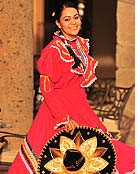 The ethnic interminglings of the Mexican people reflect the country’s rich history. Widespread intermarriage and racial mixing between Spaniards and Native Americans resulted from the Spanish conquest of the Aztec empire in the early 16th century. Native Americans accounted for nearly two-thirds of the population in the region as late as the early 19th century. However, the racial composition of the country then began to change from one featuring separate European (Spanish) and indigenous populations to that of the mestizos, people of mixed Spanish and Native American descent.
Three centuries of Spanish colonization was marked by discrimination against the mestizos, but the end of the 19th century marked the mestizos as the largest population group in Mexico, and they now account for about 60 percent of Mexicans. Life expectancy at birth is now over 75 years (approximately 72 for males and 78 for females), with the median age being 25 years. In July of 2005, the country’s population was 106,202,903.
Mexican children traditionally are given both their father's last name and their mother's maiden name, preserving the parents’ heritage. Fathers often weave a symbolic “God's Eye” when their children are born. A God’s Eye is a simple weaving made across two sticks, and is a symbol of the power of seeing and understanding unknown things. They are thought to have originated with the Huichol Indians of Jalisco, Mexico. The father weaves a God's Eye for five successive birthdays, if the tradition is fully carried out.
The Spanish colonizers converted many Native Americans and mestizos to Roman Catholicism, and along with adopting the conqueror’s religion, the natives also adopted the Spanish language.
The result is a certain religious and cultural homogeneity: The vast majority of Mexicans, about 90 percent, are Catholic and speak Spanish. The most common of the many Native American languages is Nahuatl, spoken by nearly 8 percent of Mexicans. More than 90% of the population is literate. In recent years, Mexicans have moved in large numbers from rural to urban settings; in 2003, 75 percent of Mexicans resided in urban areas, with half of those citizens living in cities of 100,000 or more.
Mexico City is one of those cities, and it’s one of the largest in the world. It was built on the site of the ancient city of Tenochtitlán, which was built by the Aztecs in 1325. The Spanish destroyed it during the Conquest. With fewer than 200 soldiers and a few horses, Hernando Cortez first entered the Valley of Mexico in 1519, and soon after, conquered the Aztec people. In 1521, the Spanish destroyed Tenochtitlán.
Modern Mexico City has some serious air and water pollution issues; the country in general suffers from water problems in various areas, as well as deforestation, erosion, desertification and land subsidence from groundwater depletion. In 2001, 13% of the country was considered arable land, with 1.31% hosting permanent crops.
 Mexico’s mingling of indigenous and Spanish-European influences has affected much of its culture and many of its traditions. Mexico has been heralded internationally for the contributions of its 20th-century mural artists, who have created artworks that reflect not only Mexico’s history and culture, but also its current social issues.
Mexico’s rich ethnic heritage in art and architecture has contributed to the development of captivating folk art, tangy cuisine and lively music, all of which are also now found throughout the United States.
Mexico is the world's greatest producer of silver, and also has significant assets of zinc, lead, gold, mercury, coal and copper. However, since the 1970s, its primary income-producing resource has been petroleum. Over 70% of its revenue comes from exporting petroleum to the United States.
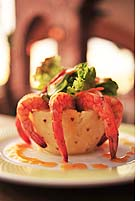 Half of the cultivated land in Mexico is devoted to corn, the country’s main food staple. Corn is a venerable crop—10,000 years ago, Indians living in what is now central or southern Mexico ate corn from wild plants; they learned how to grow corn themselves some time later. Corn is the prime ingredient in the tasty—and ubiquitous—flat “pancake” called the tortilla. The adaptable tortilla is often folded and stuffed with different foods to make tacos and similar delights, such as tortas, pozole, quesadillas, enchiladas and others.
Typical—if such widely varied cuisine can be deemed “typical”—Mexican food contains influences from Indian, Spanish, French and even Moorish and Chinese dishes. Mexican cuisine has even been recognized as an important part of the world's intangible cultural heritage by UNESCO.
Many Mexican dishes are hot and spicy, lending a distinctive flavor even to familiar foods cooked with a Mexican flair.
The nation's favorite festive dish is mole de guajolote. Guajolote is turkey, and mole (MOH-leh) is a rich, thick sauce made from various chiles, chocolate, ground peanuts, spices and sesame seed. More common dishes are those made of either frijoles (beans) cooked in various ways, or rice combined with vegetables, eggs, chicken livers or plantains.
Guacamole is a topping or salad that consists of mashed avocado seasoned with onion, hot peppers and tomato. Guacamole is often paired with granada (pomegranate) and totopos (fried tortillas). Fruit pastes called ates (AH-tehs) are typical Mexican desserts; also there are cajetas (kah-HEH-tahs), chongos and jamoncillos.
Mexican beers are in good standing around the world, and their domestic wines are developing a solid reputation. The several varieties of the maguey (mah-GAY) plant, a cactus-like jack-of-all-trades, produce aguamiel and pulque (central Mexico), mezcal (Oaxaca), tequila (Jalisco), comiteco (Chiapas), charanda (Michoacán), zotol (Chihuahua) and bacamora (Sonora).

Book your stay at select villas and enjoy a complimentary night on longer stays and flexible booking policies for a limited time.
More Details...